
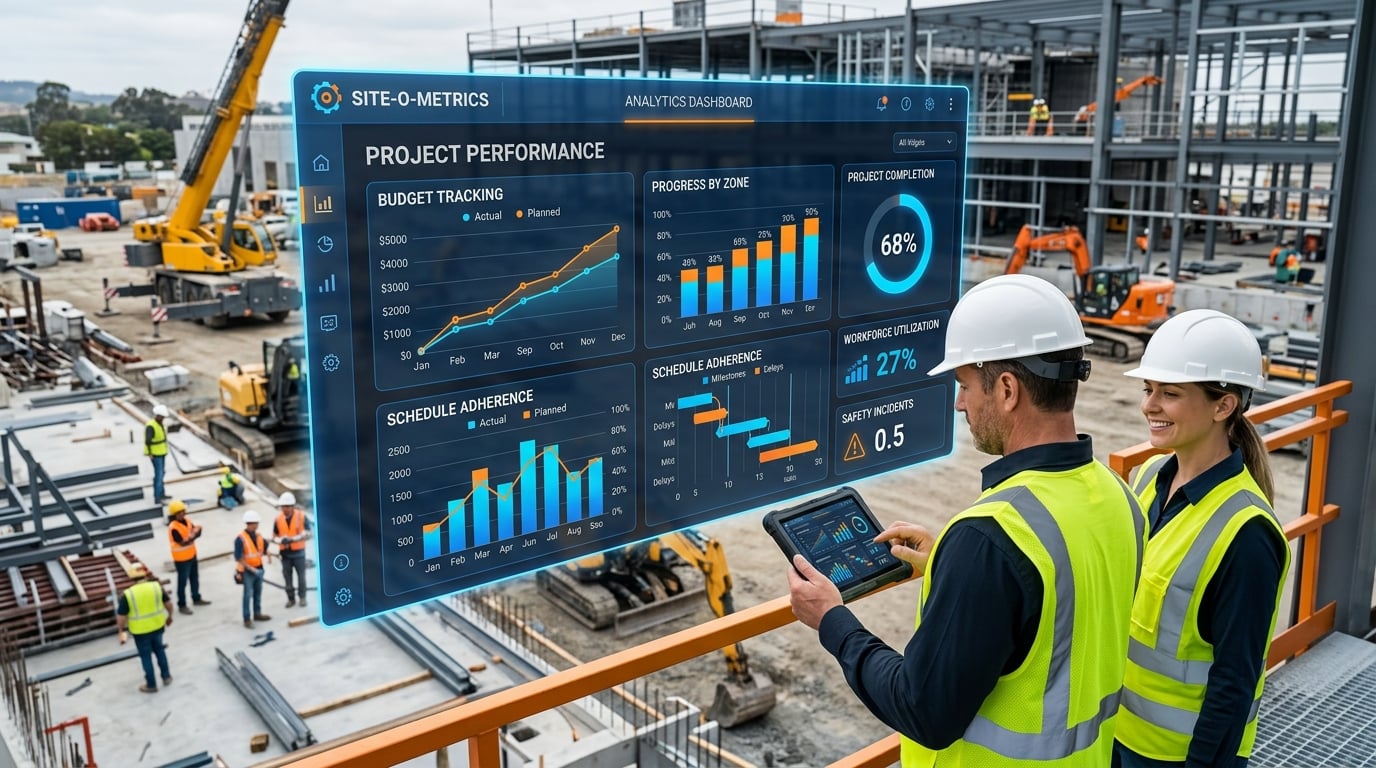
Construction has traditionally been an industry that runs on experience and intuition. Seasoned professionals make critical decisions based on years of accumulated knowledge, and that expertise remains invaluable. But in 2026, the most competitive firms are augmenting that experience with something powerful: data.
The Data Opportunity
Every construction project generates enormous amounts of data:
- Compliance data — inspection results, consent processing times, defect rates, code compliance outcomes
- Contract data — variation rates, claim histories, payment patterns, dispute frequencies
- Operational data — labour productivity, material waste rates, equipment utilisation, schedule performance
- Financial data — cost per square metre, margin analysis, cash flow patterns, overhead ratios
Historically, most of this data was locked away in filing cabinets, scattered spreadsheets, or individual people's heads. Digital tools are finally unlocking it.
What Leading Firms Are Doing
Compliance Analytics
Firms using digital compliance tools across multiple projects can now analyse patterns that were previously invisible:
- Which types of defects are most common in their portfolio — and whether they're trending up or down
- Which subcontractors consistently deliver compliant work — and which ones require more supervision
- Where in the compliance process delays typically occur — enabling proactive intervention
- How inspection pass rates vary by project type, location, and team composition
This information transforms compliance from a reactive, project-by-project activity into a strategic capability that improves over time.
When teams use Kompliy's tools — ConsentNZ for post-consent compliance, ContractGuard for contracts, Approvios for approvals — across their portfolio, these analytics emerge naturally from the data generated during normal work.
Contract Performance Analysis
AI-powered contract management tools generate rich data about contractual performance:
- Variation rates by contract type, project type, and counterparty
- Common risk areas in contracts — which clauses are most frequently triggered
- Claim patterns — the types of claims that arise most often and their typical outcomes
- Payment performance — how quickly claims are processed and paid
This data enables firms to negotiate better contracts, manage risks more effectively, and identify potential issues before they escalate.
Predictive Project Planning
With enough historical data, firms can start making predictions:
- How long will consent processing actually take for this type of project, in this council area?
- What's the likely variation rate based on the project's characteristics?
- Where are the highest compliance risks based on the design, materials, and construction method?
- What resources will be needed for quality assurance and inspection at each project stage?
These predictions enable more accurate planning, better resource allocation, and fewer surprises during delivery.
Building Your Data Capability
Step 1: Digitise Your Core Processes
You can't analyse data you don't have. The first step is moving your key processes — consent management, contract management, inspection and compliance — onto digital platforms that capture data systematically.
The Kompliy suite is designed for exactly this: each tool captures structured data as part of its normal workflow, without requiring additional data entry.
Step 2: Standardise Your Data
Consistency is critical for analytics. Ensure that your team uses consistent terminology, categories, and classifications across projects. This means:
- Standard defect categories and severity ratings
- Consistent project type classifications
- Standard contract clause references
- Uniform reporting formats
Step 3: Start Simple
You don't need a data science team to start getting value from construction analytics. Begin with simple metrics:
- Consent processing time trends
- Inspection pass rates by project and trade
- Variation rates and values
- Time from inspection to issue resolution
Track these metrics monthly and look for patterns.
Step 4: Ask Better Questions
As your data matures, you can ask increasingly sophisticated questions:
- What distinguishes our most profitable projects from our least profitable?
- What are the leading indicators that a project is heading for compliance trouble?
- How does our quality performance compare to industry benchmarks?
- Where should we invest in training to get the biggest quality improvement?
Step 5: Build a Data Culture
Data analytics isn't just a technology initiative — it's a cultural shift. Encourage your team to:
- Make data-driven arguments — back up recommendations with evidence
- Share insights across projects and teams
- Challenge assumptions with data
- Learn from patterns — both successes and failures
The Competitive Advantage
Firms that build strong data capabilities enjoy several competitive advantages:
- Better pricing — because they understand their true costs and risks
- Fewer disputes — because they manage contracts and compliance proactively
- Higher quality — because they identify and address issues systematically
- Stronger client relationships — because they can demonstrate their performance with data
- Faster growth — because they can scale their operations with confidence
The construction firms that will lead the industry in the coming decade aren't just the ones that build the best buildings. They're the ones that use data to make the best decisions — at every level, on every project, every day.